

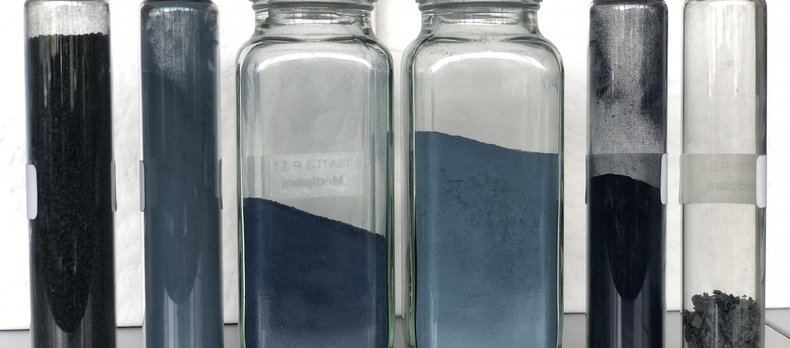
Over the course of ten years of collaboration between PhytoArk and Mediplant, numerous concrete projects have been developed. Among them: Indigo. The natural indigo pigment can be extracted from a plant native to the canton of Valais, Isatis tinctoria L., or “dyer’s woad.” Convinced of the need to make textile dyes more environmentally friendly and wishing to contribute to this initiative and progress, Mediplant was able to begin its research on natural indigo in 2020 thanks to support from The Ark Foundation, in collaboration with the Agroscope Conthey federal research station and the company RedElec Technologie (Riddes). “After three years of work optimizing the processes, we are now able to produce very high-quality natural indigo powder,” explains Audrey Kuhn, business developer at Mediplant.
For Mediplant, this project has enabled them, since early 2023, to continue and expand their research on dye plants by participating in the European AlpTextyles project, supported by Interreg. The project aims to establish a more sustainable and environmentally friendly textile industry and consumption model, particularly by passing on the ancestral textile traditions of the Alpine region. “My role involves conducting bibliographic research on textile traditions—and more specifically on dye plants—in Valais, as a basis for developing natural pigments at the Mediplant laboratory. I then need to present the results and move forward in collaboration with the project’s twelve European partners.”
“These projects are outstanding initiatives focused on environmental stewardship and sustainable development. They are wonderful vehicles for progress and for showcasing Mediplant’s work, both in Switzerland and abroad,” adds Audrey Kuhn.
Natural plant-based ingredients—whether they are cosmetic or medicinal actives or pigments—must be expertly extracted from plants. PhytoArk’s technology platform is the essential tool for this purpose. With Mediplant’s expertise and skills in operating this platform, the technical and scientific conditions are in place to successfully carry out R&D projects, from laboratory development through to pre-industrial-scale production.
Isatis tinctoria: A Closer Look at a Plant with Many Benefits
PhytoArk’s mission is to promote alpine plants and natural ingredients. Among these plants, Isatis tinctoria is one of Audrey Kuhn’s favorites. She tells us more about it.
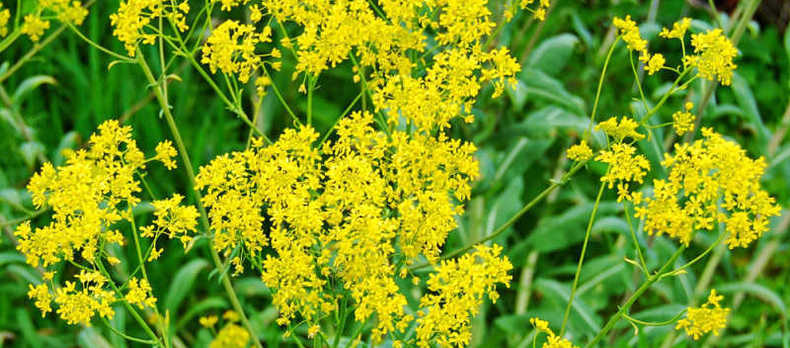
Dyer’s woad (the common name for Isatis tinctoria) is a wild plant that grows along roadsides and in vineyards in Valais. “It’s one of the first to bloom in early spring. Its flowers are yellow. It can only thrive here in the Rhône Valley because it needs a dry, warm climate,” notes Audrey Kuhn. It was widely cultivated in Europe during the Middle Ages and the Renaissance for the production of indigo dye. “Without revealing our manufacturing process, which remains confidential, we can say that for indigo production, we harvest the aerial parts of the plant.”
But it is not only a source of blue pigment; it was also used as a medicinal plant by the ancient Greeks and Romans. This comes as no surprise to me, because, like any plant rich in polyphenols, it most certainly possesses valuable medicinal properties. Take, for example, the Greek physician and pharmacologist Dioscorides (1st century), who prescribed the leaves as poultices to treat wounds, injuries, edema, and tumors (healing, antiseptic, and hemostatic properties), or the fact that it was used in the 18th century as a decoction against spleen diseases and as an antiscorbutic. It also possesses fungicidal properties.
“With the aim of reviving this plant, which embodies the essence of the Valais region, and harnessing its potential, Mediplant seeks to develop eco-friendly production of high-quality natural indigo using innovative technological methods and ensuring traceability throughout the entire supply chain,” concludes Audrey Kuhn.